
Introduction
Full stack development has become one of the most popular career paths in the software industry. Many companies prefer developers who can work on both the front-end and back-end of web applications.
Among the modern technologies used in full stack development, MERN Stack and MEAN Stack are widely used frameworks for building scalable web applications.
For students and professionals planning to join a Full Stack Developer course in Chennai, understanding the difference between these two stacks can help in choosing the right learning path. This guide explains the technologies behind MERN and MEAN stacks, their differences, and how to decide which stack suits your career goals.
What is a Technology Stack?
A technology stack refers to a combination of programming languages, frameworks, and tools used to build a web application.
A full stack typically includes:
- Front-end technologies
- Back-end technologies
- Database systems
- Server environments
Both MERN and MEAN stacks follow this architecture and use JavaScript as the primary programming language.
What is MERN Stack?
MERN Stack is a collection of technologies used to build modern web applications.
The acronym MERN represents four technologies:
- MongoDB – Database used to store application data
- Express.js – Backend framework used for server-side development
- React.js – Front-end library used for building user interfaces
- Node.js – Runtime environment used to run JavaScript on the server
MERN Stack allows developers to use JavaScript across the entire application, which simplifies development and improves efficiency.
What is MEAN Stack?
MEAN Stack is another popular full stack development framework.
MEAN stands for:
- MongoDB – Database system
- Express.js – Backend framework
- Angular – Front-end framework
- Node.js – Server runtime environment
Like MERN, the MEAN stack also uses JavaScript for both front-end and back-end development.
Key Differences Between MERN and MEAN Stack
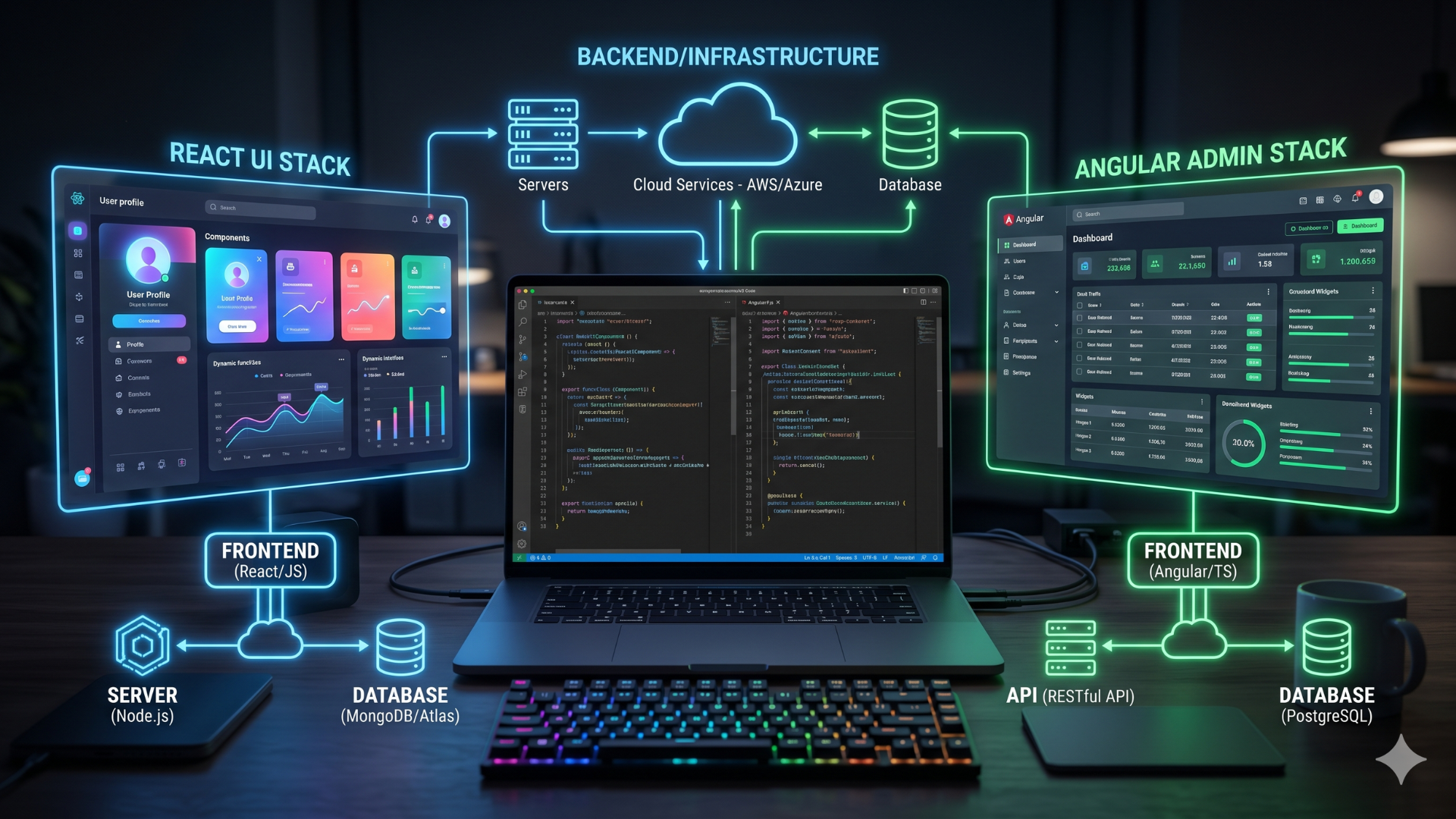
Although both stacks share many similarities, the primary difference lies in the front-end technology used.
Front-End Framework
MERN uses React, while MEAN uses Angular. React is a lightweight library that focuses on building user interfaces, whereas Angular is a complete front-end framework with many built-in features.
Learning Curve
React is generally considered easier to learn because it focuses mainly on the user interface. Angular includes more features and structure, which may require additional learning.
Flexibility
MERN stack offers more flexibility because developers can choose additional libraries when needed. Angular provides a structured environment with built-in tools.
Performance
Both stacks can build high-performance applications, but the performance may vary depending on the project architecture and implementation.
MERN Stack Advantages
MERN stack has gained popularity among developers for several reasons.
Some advantages include:
- Large developer community
- Flexible architecture
- Reusable components in React
- Efficient single-page application development
React-based applications are commonly used by modern web platforms.
MEAN Stack Advantages
MEAN stack also offers several benefits for developers and organizations.
Key advantages include:
- Structured development environment
- Built-in tools and modules in Angular
- Efficient development using TypeScript
- Suitable for enterprise-level applications
Angular is often used in large-scale applications that require structured architecture.
Which Stack Should You Learn?
Choosing between MERN and MEAN stack depends on several factors.
Career Goals
If you are interested in working with modern web interfaces and flexible frameworks, MERN stack may be suitable. If you prefer a structured development environment with built-in features, MEAN stack may be a better choice.
Industry Demand
Many startups and modern web platforms prefer React-based applications, while Angular is often used in enterprise environments.
Learning Preferences
Beginners often start with MERN stack because React can be easier to understand compared to Angular.
Skills You Will Learn in a MERN or MEAN Stack Course
A typical full stack training program includes several important skills.
Students usually learn:
- HTML and CSS for web design
- JavaScript programming
- Front-end frameworks such as React or Angular
- Backend development using Node.js and Express
- Database management using MongoDB
- API development and integration
These skills help developers build complete web applications.
Career Opportunities After Learning MERN or MEAN Stack
Developers trained in modern full stack frameworks can pursue several roles in the software industry.
Common job roles include:
- Full Stack Developer
- Web Application Developer
- Front-End Developer
- Back-End Developer
- Software Engineer
These roles are available in startups, IT services companies, and technology organizations.
FAQs
Conclusion
Both MERN and MEAN stacks are powerful technologies used to build modern web applications. Each stack offers its own advantages depending on the project requirements and developer preferences.
For students planning to enroll in a Full Stack Developer course in Chennai, understanding these frameworks can help in choosing the right specialization. Learning either MERN or MEAN stack can open opportunities in the rapidly growing field of web development.